7 Foam Roller Mistakes to Avoid for Forearm Pain

Last Updated: November 4, 2026
Quick Summary
Forearm pain from a foam roller usually means the roller is being used wrong, not that the muscles can't handle it. Most people press too hard, roll too long, or aim at the wrong spot. Keep pressure light, roll the muscle belly slowly for 2 to 5 minutes per arm, and avoid the wrist and elbow.
- Aim for pressure around 4 or 5 out of 10, where you can still breathe normally.
- Roll slowly from the elbow toward the wrist at about one inch per second.
- Avoid the bony ridge along the ulna, the wrist joint, and the elbow crease.
- Limit each arm to about 2 to 5 minutes per session.
- Stop and seek advice if numbness, tingling, or sharp pain continues.
Table of Contents
- Why Forearm Muscles Get Tight in the First Place
- How to Foam Roll Your Forearms Step by Step
- How to Fix Tight Forearm Muscles Beyond Rolling
- How Long to Foam Roll Forearms Per Session and Per Week
- Best Tools for Forearm Muscle Tension: Foam Roller, Arm Massager or Ball
- Mistakes That Make Forearm Pain Worse
- Where to Go From Here: Building a Forearm Routine That Fits Your Day
- Frequently Asked Questions
Forearm pain from a foam roller is often a sign that the roller is being used wrong, not that the muscles can't handle it.
A foam roller is a simple cylinder you use to apply pressure to a muscle group. The forearm is a small, sensitive area, so the rules are different from rolling a thigh or back. For the broader topic, see our guide on how to fix tight forearm muscles.
Why Forearm Muscles Get Tight in the First Place
Forearm tension usually builds from repeated, small movements of the hands and wrists over long periods. Typing, playing an instrument, climbing, and lifting all load the same muscles again and again. Knowing what causes the tension helps you choose where to roll and how hard.
Flexors and extensors: what each group does
The forearm has two main muscle groups. The flexors sit on the inside (palm side) of the forearm and help you close your hand and bend your wrist. The extensors sit on the top (back of the hand side) and help you open your hand and lift your wrist. Most people's daily work loads one group more than the other.
Common everyday triggers: typing, instruments, climbing and lifting
Some activities put steady strain on the forearm:
- Typing and mouse use: long hours with the wrist resting or bent
- Playing instruments: guitar, piano, and violin all involve repeated finger and wrist work
- Climbing: gripping small holds loads the flexors heavily
- Lifting and gripping: weights, tools, and bags add load to the whole forearm
Recognizing your trigger helps you decide whether the fix is rolling, a change in habits, or both.
How to Foam Roll Your Forearms Step by Step
Rolling the forearm is simple, but the technique matters. The forearm is a small, sensitive area with nerves and tendons close to the surface, so the rules are different from rolling a thigh or back.
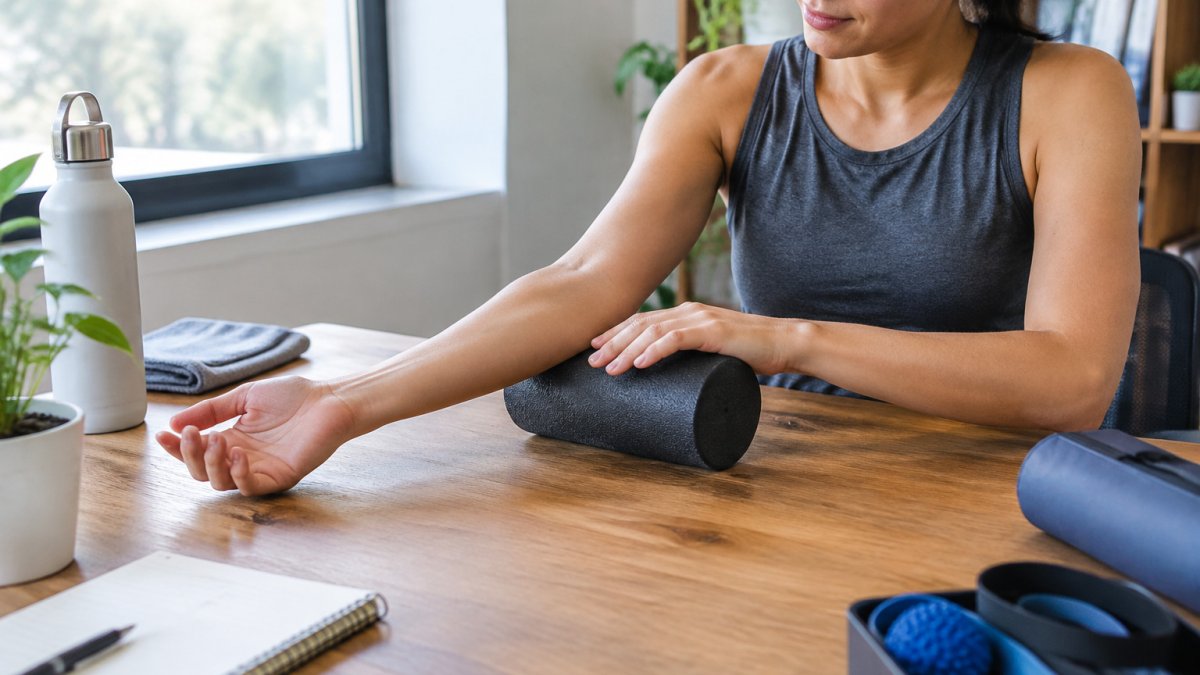
- Sit comfortably. Rest your forearm on a table with your palm facing up. For a more hands-on approach beyond these rolling steps, see this deep tissue forearm massage guide with step-by-step technique and safety tips. Keep your shoulder relaxed and your elbow bent at about 90 degrees.
- Place the roller. Set the foam roller under the fleshy part of your forearm, just below the elbow. Avoid the bony ridge along the ulna (the pinky-side bone), roll on the muscle belly, not the bone.
- Support your weight. Use your other hand or elbow to hold most of your body weight. Keep the pressure light at first, you should feel a mild, diffuse pressure, not a sharp pinch.
- Roll slowly. Move the roller from the elbow toward the wrist at about one inch per second. Slow, controlled passes are more useful than fast back-and-forth scrubbing.
- Pause on tender spots. If you hit a tight area, hold for 15 to 20 seconds while breathing slowly. If the sensation is sharp or electric, move off the spot immediately.
- Switch sides. Repeat on the top and bottom of the forearm. The flexor side (palm up) and extensor side (palm down) often feel different, spend more time on whichever side feels tighter.
- Finish gently. Stop rolling when the muscle feels looser, not when it hurts. A session of 2 to 5 minutes per arm is usually enough.
Watch out: Never roll directly over the wrist joint, the elbow crease, or any area with sharp pain, numbness, tingling, or a visible bruise. Those spots need a different approach, pressure there can irritate nerves and tendons rather than relax muscle.
Pressure control: how hard is too hard?
A common pattern is for people to press as hard as they can because they assume more pressure equals more benefit. For the forearm, the opposite is often true. A useful rule of thumb: aim for a pressure you would rate 4 or 5 out of 10, where 10 is the most uncomfortable pressure you could tolerate. If you find yourself tensing your hand or holding your breath, you are pressing too hard.
When not to roll: contraindications to know
Most foam-rolling content focuses on how to roll and skips when not to. Skip rolling, and check with a qualified healthcare professional, if you have any of the following:
- Acute inflammation: heat, swelling, or redness in the forearm that started recently
- Nerve symptoms: numbness, tingling, or weakness in the hand or fingers that worsens with rolling
- A recent injury: a strain, sprain, or bruise that is still healing
- Sharp or electric pain: pain that feels like a shock or shoots down the arm
- A visible lump or swelling: any new bump you cannot explain
These are general wellness guidelines, not a diagnosis. If you are unsure whether rolling is appropriate for your situation, ask a qualified healthcare professional before starting.
How to Fix Tight Forearm Muscles Beyond Rolling
Rolling is one tool among several. Lasting relief usually comes from combining it with stretching and changes to your daily setup.
Gentle stretching after rolling
A short stretch after rolling helps the muscle settle. Extend one arm with the palm facing down, then gently pull the fingers back toward you with the other hand until you feel a mild stretch along the top of the forearm. Hold for 20 to 30 seconds. Then turn the palm up and repeat for the inside of the forearm. Stretch slowly and never bounce.
Ergonomic changes at your desk or instrument
Small setup changes often reduce load more than any roller. Keep your wrists relaxed and mostly straight while typing. Rest your forearms on the desk or armrests so the muscles don't hold the weight. For instruments, check that your grip and hand position aren't forcing unnecessary tension. Taking short breaks every 30 to 45 minutes gives the forearm time to recover.
Roleo Arm & Hand Massager – BACK IN STOCK! Effective, easy to use. Our →
How Long to Foam Roll Forearms Per Session and Per Week
Less is usually better for the forearm. A typical session lasts 2 to 5 minutes per arm, with light pressure. Rolling for longer rarely helps and often leaves the muscle sore.
Think of the question as two parts. Per session, keep it brief. Per week, consistency beats intensity: several short, gentle sessions usually help more than one long, hard one.
Best Tools for Forearm Muscle Tension: Foam Roller, Arm Massager or Ball
Each tool suits a different need, and the right choice depends on where you feel tension, how much control you want, and where you plan to use it. Use this summary to choose:
Tool |
Pressure |
Best for |
Watch for |
|---|---|---|---|
Foam roller |
Broad, adjustable |
Larger forearm areas and general loosening |
Too much pressure on the wrist; awkward on a small limb |
Arm massager |
Targeted, controlled |
Specific tight spots and desk-side use |
Overuse on one area |
Massage ball |
Firm, concentrated |
Small, stubborn knots |
Pressing too hard; hard to control on thin tissue |
How to choose between them
A foam roller is the most familiar option, but its size can make it awkward on a forearm, you end up using your other hand to stabilize it, which adds tension rather than releasing it.
A practical approach is to match the tool to the moment. Use a foam roller or ball when you have floor space and time for a longer session.
Ergonomic workspace integration: a routine for desk workers
Most forearm tension builds quietly during long desk sessions, and most rolling content ignores the desk entirely. A simple preventative routine can fit into a workday without extra equipment:
- Every 30 to 45 minutes: take a 60-second break. Set your hands in your lap, roll your shoulders back, and gently open and close your hands a few times.
- Mid-morning and mid-afternoon: spend 2 minutes with a handheld massager or ball on the forearm, focusing on whichever side feels tighter.
- End of workday: do a 3-minute gentle roll or massage pass, then a short stretch (see the stretching section above).
- Desk setup check: keep wrists relaxed and mostly straight while typing, rest forearms on the desk or armrests so the muscles are not holding the weight of your arms, and keep the mouse close enough that you are not reaching.
The Roleo Arm & Hand Massager is designed for targeted self-massage of the forearms, wrists, and hands. It is a non-electric, portable option that works at home, at a desk, or on the go. Its adjustable pressure makes it easier to start gently, and it can be a practical choice for people who find a full-size roller awkward on the forearm or who want a tool they can use during short work breaks without setting up floor space.
Mistakes That Make Forearm Pain Worse
These are the errors that most often turn a helpful habit into a painful one:
- Pressing too hard: Forearm tissue is thin. Light pressure works better.
- Rolling too long: Several minutes on one spot can cause soreness.
- Rolling the wrist or elbow: These joints need care, not pressure.
- Skipping warm-up: Roll after your arms have warmed up, not on cold muscles.
- Ignoring numbness or sharp pain: Stop and seek advice if symptoms persist.
- Expecting instant results: Gradual changes over weeks are normal.
- Using one tool for everything: Mix tools to match your needs.
If pain, numbness, or weakness continues, speak with a qualified healthcare professional. This guide covers general wellness only.
Where to Go From Here: Building a Forearm Routine That Fits Your Day
Start small. Choose one or two habits, such as a brief roll each evening and a stretch after your longest work block. For a fuller plan covering home and office, read our hand, wrist and arm tension guide.
If you want a tool to make rolling easier, the Roleo Arm & Hand Massager offers adjustable, portable self-massage for the forearms and hands. It’s like two foam rollers in one device, and you control the pressure by how you position your arm and by using the adjustment knob on top.

Frequently Asked Questions
How do you properly use a foam roller on your forearms?
Sit with your forearm resting on a table and the roller underneath it. Use your other hand to press gently and roll slowly from near the elbow toward the wrist, pausing on tender spots for a few seconds. Keep the pressure at a level you can comfortably tolerate. Switch sides, then turn your forearm over to reach the other muscle group. Stop if you feel sharp or numbing sensations and check with a healthcare professional if discomfort persists.
Is a foam roller useful for tendonitis?
Foam rollers are a general self-massage tool and are not a treatment for tendonitis or any other medical condition. Many people use them to ease surrounding muscle tightness as part of a general wellness routine. Because tendon pain can have several causes, a healthcare professional should assess persistent or worsening symptoms. Avoid rolling directly over an inflamed or painful tendon, and stop if pressure makes symptoms worse.
How long should you foam roll your forearms?
Most people spend about one to two minutes per forearm per session, rolling slowly and pausing briefly on tight areas. Several short sessions across the week are generally more comfortable than one long session. Keep sessions gentle, since more pressure does not necessarily mean better results. If you notice soreness that lasts beyond a day, reduce the time or pressure next time.
Where should you not use a foam roller?
Avoid rolling directly over joints such as the elbow or wrist, over bruises, swollen areas, open skin, or recently strained tissue. Do not press on the front of the neck or other areas with major nerves or blood vessels close to the surface. If you have an injury, a diagnosed condition, or pain that is sharp, numb or worsening, speak with a healthcare professional before rolling that area.
Our team at Roleo Massager has put this routine together to help you keep your arms comfortable through busy days. Start with two minutes, two days a week, and build from there.

- Paul Kleiman