How to Relieve Forearm Muscle Tightness: A 2026 Guide
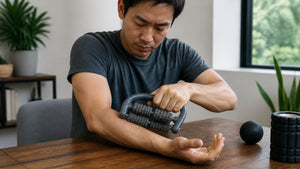

Table of Contents
- Why Forearm Tightness Happens and What It Feels Like
- Stretches for Forearm Comfort: A Daily Flexibility Routine
- Best Tools for Forearm Muscle Tightness: Massagers and Rollers
- How to Use a Forearm Massager for Targeted Relief
- Strengthening and Mobility Exercises to Prevent Recurrence
- Ergonomics and Workload Management for Long-Term Comfort
- Conclusion: Building a Consistent Forearm Care Routine
- Frequently Asked Questions
Last Updated: October 5, 2026
Why Forearm Tightness Happens and What It Feels Like
Forearm muscle tightness is a feeling of stiffness, pulling, or soreness in the muscles between your elbow and wrist.
Most people notice it as a dull ache after typing, a stiff grip after climbing, or a tired forearm after playing an instrument.
The good news: tight forearm muscles usually respond well to simple daily care. Below, we explain what causes the tightness and how to relieve forearm muscle tightness at home.
A Quick Look at Forearm Anatomy
Your forearm contains two main muscle groups that work as a team:
- Wrist and finger flexors sit on the palm side of your forearm. They close your hand and bend your wrist forward. Think of gripping a bar, holding a mouse, or making a fist.
- Wrist and finger extensors sit on the back of your forearm. They open your hand and bend your wrist backward. Think of releasing a grip, typing, or lifting your fingers off a keyboard.
These groups are opposing forces. When one side stays contracted for long periods, the other side can become overstretched or fatigued. That imbalance is often what you feel as tightness, pulling, or a dull ache.
Using Symptom Location to Guide Your Approach
Where you feel tightness, and what movement brings it on, can help you choose which area to focus on first. This is not a diagnosis, but a practical way to direct your daily care.
- Palm-side tightness that worsens when you grip or curl your fingers points toward the flexor group. Gripping sports, manual work, and heavy phone use often land here.
- Back-of-forearm tightness that worsens when you type or extend your fingers points toward the extensor group. Keyboard work and racket sports often land here.
- Tightness near the elbow may involve the muscles that cross the elbow joint. These respond well to slow, controlled stretching rather than aggressive pressure.
- Tightness that spreads into the hand or fingers is worth mentioning to a professional, especially if it comes with numbness or tingling.
A simple test: press gently along the palm side, then the back side. Note which area feels tender or ropey. That is usually the side that needs more attention in your routine.
Common Causes: From Keyboards to Climbing Holds
The causes fall into a few clear groups. Most people deal with more than one at a time.
- Long hours at a keyboard. Typing and mouse work keep your wrist and finger muscles lightly tensed all day.
- Gripping sports. Tennis, pickleball, golf, and climbing all ask your hands to hold on tight.
- Playing an instrument. Guitarists and pianists use the same forearm muscles for hours of practice.
- Manual work. Plumbers, electricians, and carpenters repeat the same gripping motions all day.
- Phone scrolling. Holding a phone for long stretches keeps the forearm muscles switched on.
The pattern is the same in every case: repeated use without rest. Many people find that a short daily routine does more good than one long session once a week.
When to See a Professional About Forearm Discomfort
Most everyday tightness eases with rest and gentle movement. Some signs mean you should get a professional opinion first.
See a doctor or physical therapist if you notice:
- Numbness or tingling in your fingers or hand
- Weakness that makes you drop things
- Sharp pain instead of a dull ache
- Swelling, redness, or warmth in the forearm
- Symptoms that last weeks with no improvement
These signs can point to something beyond simple muscle tension. A qualified professional can assess what is going on and guide your next steps. This article covers general wellness care, not medical advice.
Stretches for Forearm Comfort: A Daily Flexibility Routine
Stretches for forearm comfort work best as a short daily habit. Five minutes, once or twice a day, keeps the muscles flexible.
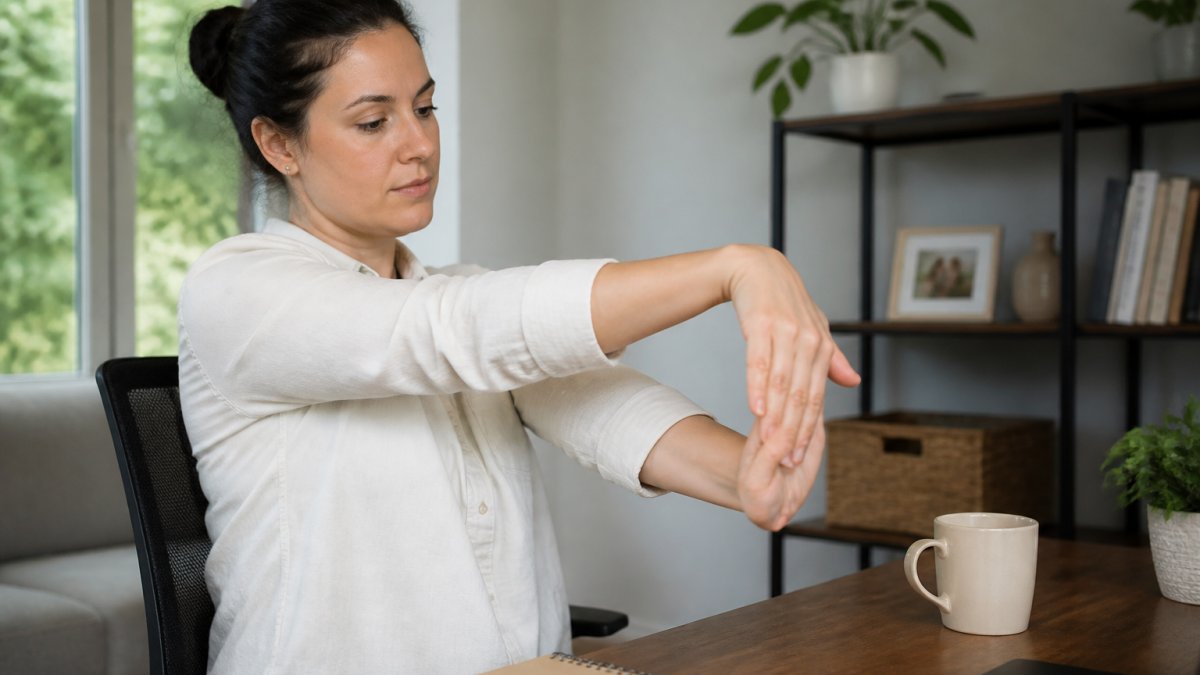
Do each stretch gently. You should feel a mild pull, never sharp pain.
- Wrist flexor stretch. Extend one arm, palm up. Use your other hand to pull the fingers down and back. Hold 10-15 seconds. Repeat 3 times.
- Wrist extensor stretch. Extend one arm, palm down. Use your other hand to pull the fingers down toward the floor. Hold 10-15 seconds. Repeat 3 times.
- Wrist circles. Make slow circles with your wrist, 10 in each direction. This warms the joint and boosts wrist mobility.
- Finger spread and fist. Spread your fingers wide, then make a soft fist. Repeat 10 times.
- Gentle shake-out. Shake your hands loosely for 10 seconds to release leftover tension.
Warm up first. Cold muscles stretch less safely, so do these after a shower or a few minutes of movement. Stop if anything hurts.
Best Tools for Forearm Muscle Tightness: Massagers and Rollers
The best tools for forearm muscle tightness are ones that fit the shape of your arm. That is the gap the Roleo Arm and Hand Massager was built to fill.

The Roleo works like an old-fashioned clothes wringer. You roll your forearm through it, and the spring-loaded rollers press into the muscle.
Why we recommend it:
Roleo Arm & Hand Massager – BACK IN STOCK! Effective, easy to use. Our →
- It fits the forearm. The rollers wrap around the arm instead of rolling across it.
- No batteries or charging. It is fully portable and works anywhere.
- Adjustable pressure. You set the depth by how you roll.
- Trusted since 2006. Physical therapists, massage therapists, and trainers use it.
For lighter, broader work, the Roleo Leg Massager also rolls arms, with an effleurage action that encourages circulation. It costs less and suits warm-ups and cool-downs.
Tool |
Best For |
Pressure Control |
Power |
|---|---|---|---|
Roleo Arm and Hand Massager |
Targeted forearm and hand tension |
You set it by roll speed and firmness |
None needed |
Roleo Leg Massager |
Warm-ups, cool-downs, broader arm and leg work |
Spring-loaded, angle changes tension |
None needed |
Foam roller |
Large muscle groups like thighs and back |
Body weight only |
None needed |
How to Use a Forearm Massager for Targeted Relief
Knowing how to use a forearm massager makes the difference between real relief and a wasted five minutes. The steps below take about three minutes per arm.
- Warm up first. Shake out your hands and do 10 wrist circles.
- Start light. Roll your forearm through the device with gentle pressure for 30 seconds.
- Go slow. Roll from wrist to elbow, pausing on any tight spot for 5-10 seconds.
- Cover both sides. Roll the palm side, then flip your arm and roll the back.
- Work the hand too. Roll the base of your thumb and palm where tension collects.
- Finish with a stretch. Do the wrist flexor and extensor stretches from above.
- Repeat daily. Once or twice a day works better than one long weekly session.
A common mistake is pressing too hard on the first pass. Start light, then add pressure as the muscle loosens. If you have an existing injury, check with a professional before using any massage tool.
Strengthening and Mobility Exercises to Prevent Recurrence
Strengthening is the step most people skip. Stretching alone loosens the muscle, but stronger muscles handle daily load better. Add these twice a week.
A Simple Progression: Start Light, Add Slowly
Forearm muscles respond best to gradual loading. A common pattern is:
- Week 1-2: Bodyweight or very light resistance only. Focus on control and full range of motion.
- Week 3-4: Add a light weight or a slightly thicker resistance band. Keep reps the same.
- Week 5+: Increase resistance only when the current level feels easy for two full sessions in a row.
If you feel joint pain, stop and rest. Muscle soreness the next day is normal; sharp pain during the movement is not.
The Exercises
- Wrist curls. Hold a light weight, palm up. Curl the wrist up and lower slowly. 10 reps. This targets the flexor group.
- Reverse wrist curls. Same motion, palm down. This targets the wrist extensors. 10 reps.
- Towel squeeze. Roll a towel and squeeze it hard for 5 seconds. 10 reps. Builds grip strength.
- Rice bucket digs. Push and twist your hand through a bowl of rice. 30 seconds. A gentle way to work the hand and forearm together.
- Grip and release. Make a firm fist, hold 3 seconds, release. 15 reps.
- Wrist circles with light resistance. Loop a light band around your fingers and make slow circles. 10 in each direction.
Keep the weight light at first. The goal is control, not heavy lifting. Pair these with the daily stretch routine and you cover both muscle flexibility and strength.
How Often and How Long
- Frequency: Twice a week is enough for most people. Allow at least one rest day between sessions.
- Duration: The full routine takes about 8-10 minutes.
- Progression: Add resistance only when the current level feels easy for two sessions in a row.
- Deload: If your forearms feel unusually tired, skip one session and focus on stretching and light movement instead.
Mobility Work Between Strength Sessions
On your off days, keep the joints moving with gentle mobility:
- Wrist circles. 10 in each direction.
- Finger spread and fist. Spread wide, then make a soft fist. 10 reps.
- Gentle shake-out. Shake your hands loosely for 10 seconds.
These take less than two minutes and help maintain the range of motion you build with stretching.
Ergonomics and Workload Management for Long-Term Comfort
Ergonomics and workload management decide whether the tightness comes back. You can stretch and massage every day, but if your setup forces your muscles to work all day, the tension returns.
Small changes add up:
- Keep wrists neutral. Your wrist should stay straight, not bent up or down.
- Lower your keyboard. A slight downward tilt reduces wrist extension.
- Support your forearms. Rest them on the desk or armrests while you work.
- Take micro-breaks. Every 30 minutes, stand, stretch, and shake out your hands.
- Switch hands. Spread phone and mouse work between both hands where you can.
- Adjust your grip. Loosen your hold on tools, rackets, and bars.
The 30-minute rule matters most. A 30-second break every half hour beats a 10-minute break once a day. Set a timer if you forget.
Conclusion: Building a Consistent Forearm Care Routine
The real challenge is not learning the stretches. It is doing them every day, on the days you feel fine. Tightness creeps back when care stops.
Build a routine you can keep: stretch daily, strengthen twice a week, fix your setup, and take breaks. The Roleo Leg Massager adds a lighter option for warm-ups and cool-downs.

Get started with Roleo Massager and give your forearms the daily care they need.
Frequently Asked Questions
Why do my forearms feel tight after daily activities?
Forearm tightness often results from repetitive motions like typing, gripping, or lifting. Muscles and tendons become fatigued and tense when they perform the same actions without adequate rest. Desk workers, musicians, athletes, and manual laborers are especially prone. Taking regular breaks, stretching, and using a self-massage tool can help manage this tension as part of a general wellness routine.
What are some simple ways to address forearm muscle tension?
Start with gentle stretches for the wrist flexors and extensors, holding each for 10–15 seconds. Wrist circles and mobility drills keep joints lubricated. Self-massage with a dedicated tool like the Roleo Arm & Hand Massager provides deep tissue pressure to release tight spots. Consistency matters more than intensity, so a few minutes daily can make a noticeable difference in how your forearms feel.
How can I incorporate self-massage into my forearm care routine?
Set aside 5–10 minutes after work or training. Apply moderate pressure with a massager, rolling slowly from wrist to elbow. Focus on areas of tightness but avoid pushing into sharp pain. Use it before activities as a warm-up or afterward to help muscles relax. Pairing self-massage with stretches and strengthening exercises creates a complete routine that supports forearm comfort.
What are the benefits of using a dedicated arm massager for forearm comfort?
A dedicated arm massager like the Roleo offers consistent, targeted pressure that hands alone cannot sustain. It reaches deep into muscle tissue to help release tension, improve circulation, and support recovery. Many users find it more convenient than scheduling professional massages and appreciate the portability. As part of a wellness plan, it can help you maintain comfortable, fluid movement in your forearms and hands.
- Paul Kleiman