Hand, Wrist and Arm Tension Solutions for Home and Office: A 2026 Guide


Table of Contents
- What Hand, Wrist, and Arm Tension Actually Feels Like
- Signs and Causes: When Tension Starts Talking
- At-Home Comfort Strategies for Hand, Wrist, and Arm Tension
- Ergonomic Workstation Setup That Reduces Hand, Wrist, and Arm Tension
- Forearm Muscle Tension Relief: Techniques You Can Do Daily
- Best Tools for Muscle Maintenance at Home
- A Step-by-Step Recovery Timeline (and the Psychological Side Nobody Mentions)
- Conclusion
- Frequently Asked Questions
Last Updated: October 2, 2026
What Hand, Wrist, and Arm Tension Actually Feels Like
Hand, wrist, and arm tension often builds from repeated motion, sustained awkward posture, or unbroken static load on a muscle group, and it usually announces itself as a dull ache that sharpens the longer you ignore it. This guide from Roleo Massager covers how to recognize it, ease the discomfort, and rebuild your daily routine for better comfort.
Signs and Causes: When Tension Starts Talking
These signs cluster around the working muscles and the nerves passing through them, and they follow a predictable pattern: ache first, stiffness second, weakness last. Catching it at the ache stage is far easier than reversing the weakness stage.
Common Signs of Tension
The most common signs of hand, wrist, and arm tension are aching or burning in the forearm, wrist, or hand; stiffness that eases with movement but returns with rest; and a gradual loss of grip strength. Tingling or numbness in the fingers can feel different from general muscle fatigue and is worth paying attention to.
Watch for these specific signs:
- A dull ache that builds through the day and fades overnight
- Tenderness along the forearm muscle belly or at the elbow
- Reduced range of motion when you first wake up
- Clicking, creaking, or a "catching" sensation in the wrist
- Weakness when gripping, pinching, or opening jars
- Pain that now appears during activities that never used to cause it
Causes and Risk Factors
Causes fall into three buckets: repetitive motion, sustained poor body positioning, and insufficient recovery time between loads. Typing, scrolling, playing an instrument, gripping tools, and swinging a racquet all load the same forearm and wrist structures.
Risk factors that raise your odds:
- More than four hours of continuous keyboard or mouse work per day
- A workstation that forces your wrists to bend upward or sideways
- Cold environments, which reduce soft tissue elasticity
- Skipping warm-up exercises before physical work or sport
- No cool-down or stretching routine afterward
- Previous injury to the same arm
At-Home Comfort Strategies for Hand, Wrist, and Arm Tension
Easing hand, wrist, and arm tension at home works best as a structured daily routine rather than a single fix. The core components are relative rest, activity modification, temperature comfort, and targeted soft tissue work on the forearm.
Rest, Activity Modification and the R.I.C.E. Basics
Rest does not mean stopping everything. It means reducing load on the affected tissue while keeping the joint moving gently. Complete immobilization tends to make stiffness worse.
Activity modification is the practical version of rest:
- Swap a mouse for keyboard shortcuts where you can
- Alternate hands for scrolling and carrying
- Break continuous tasks into shorter blocks with movement in between
- Reduce grip force: lighter tension, looser holds, softer tools
Ice, Heat and Topical Analgesics
Ice and heat do different jobs, and using the wrong one at the wrong time is a common mistake. Cold compress reduces inflammation and numbs sharp pain in the first 48 to 72 hours. Heat relaxes muscle stiffness and improves blood flow once the acute phase has passed.
A practical sequence:
- Acute phase (first 2-3 days): cold compress for 10-15 minutes, several times daily, always with a cloth barrier
- After the acute phase: moist heat for 10-15 minutes before activity to loosen tissue
- After activity: cold again if the area feels hot or swollen
- Topical analgesics: useful for localized discomfort, applied as directed on the label
- Paracetamol: a reasonable option for general pain management, following label guidance
Stretching Routine and Nerve Gliding
A stretching routine should be gentle and frequent, never forceful. Aggressive stretching on an irritated nerve or tendon tends to flare discomfort rather than settle it.
A daily sequence that covers the main structures:
- Wrist flexor stretch: arm straight, palm up, gently draw fingers back. Hold 20-30 seconds.
- Wrist extensor stretch: arm straight, palm down, gently draw fingers down. Hold 20-30 seconds.
- Forearm rotation: elbow at 90 degrees, rotate palm up and down slowly, 10 reps.
- Nerve gliding: slow, controlled movements that take the nerve through its available range without stretching it to the point of tingling. Stop before symptoms increase.
- Trigger point release: sustained, moderate pressure on tight spots in the forearm muscle belly, held until the tissue softens.
Ergonomic Workstation Setup That Reduces Hand, Wrist, and Arm Tension
An ergonomic workstation setup reduces repetitive motion by putting your joints in neutral positions and letting larger muscle groups carry the load. Small geometry changes beat expensive equipment every time.
Roleo Arm & Hand Massager – BACK IN →
Start with these adjustments:
- Chair height: elbows level with the desk surface, feet flat on the floor
- Keyboard: flat or slightly negative tilt, close enough that your elbows stay near your sides
- Mouse: positioned so you are not reaching forward or outward
- Wrists: straight, not bent up, down, or sideways
- Monitor: top of the screen at or just below eye level
- Support: forearm support at the desk edge to offload the shoulders
Forearm Muscle Tension Relief: Techniques You Can Do Daily
Forearm muscle tension relief comes down to three techniques: sustained trigger point pressure, cross-fiber friction across the muscle belly, and effleurage strokes that move fluid and warm the tissue. All three can be done in a few minutes, seated at your desk.
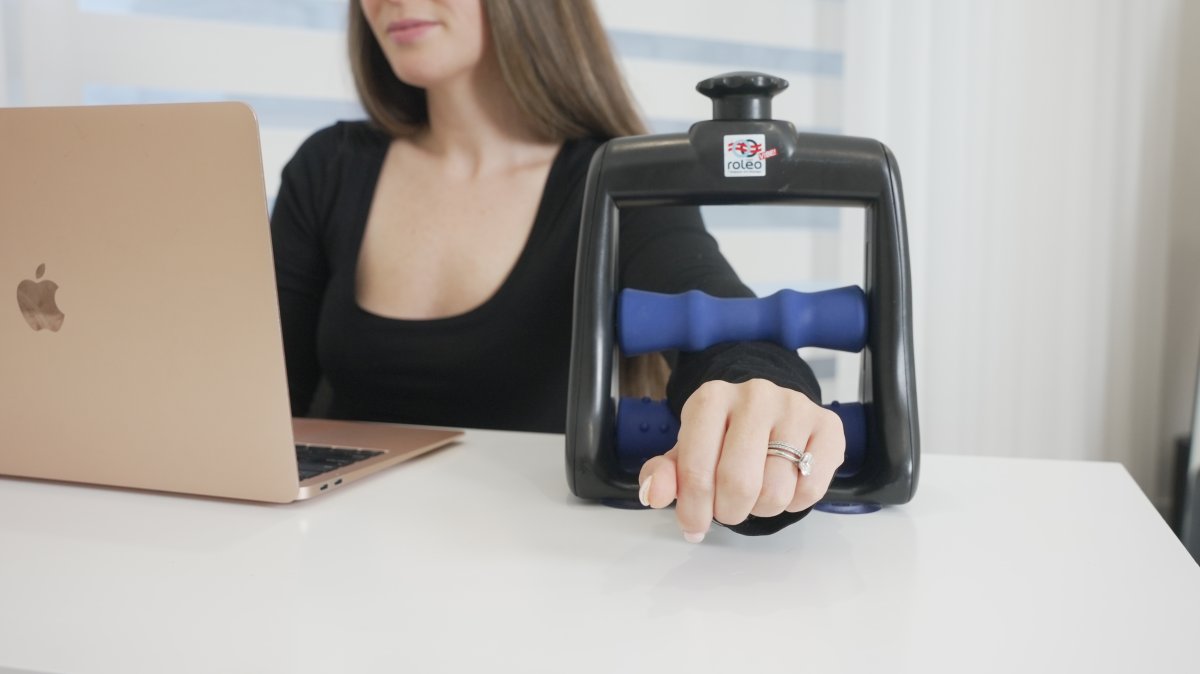
Person using a handheld massager on their forearm while seated at a desk to relieve muscle tension
Best Tools for Muscle Maintenance at Home
The best tools for muscle maintenance at home are the ones you will actually use daily, and that usually means something portable, non-electric, and quick to apply. Complexity is the enemy here.
What to look for:
- Contoured to the limb. A flat foam roller does not wrap around a forearm. Curved or wringer-style tools fit the shape of the arm and reach the muscle belly properly.
- Adjustable pressure. You need light pressure on a flare-up day and firm pressure on a maintenance day.
- No power required. Anything that needs charging will be flat when you need it.
- Portable. If it does not fit in a bag, it stays home, and travel is when tension builds.
- Durable. Daily use wears out cheap foam quickly.
A simple decision framework:
If your situation is... |
Best approach |
Why |
|---|---|---|
Forearm and wrist tension from desk work |
Wringer-style arm massager |
Contours to the forearm, adjustable pressure |
General leg and arm soreness after sport |
Roller massager |
Covers larger muscle groups, warm-up and cool-down |
Acute flare with swelling |
Cold compress first |
Reduces inflammation before any tissue work |
Chronic tightness, no swelling |
Heat, then massage |
Warms tissue so pressure releases rather than irritates |
Traveling frequently |
Non-electric, portable tool |
Works anywhere, no charging |
A Step-by-Step Recovery Timeline (and the Psychological Side Nobody Mentions)
Recovery from hand, wrist, and arm tension at home typically follows a weeks-long arc rather than a days-long one, and the timeline depends heavily on how consistently you remove the cause. Most people feel meaningful change within two to four weeks if they actually change their daily load.
A realistic sequence:
- Days 1-3: Reduce load sharply. Cold compress, relative rest, no aggressive stretching.
- Days 4-14: Introduce gentle range of motion, heat before activity, and daily soft tissue work. Keep the load reduced.
- Weeks 3-6: Rebuild capacity. Add strengthening, extend work intervals gradually, keep the stretching routine.
- Weeks 6-12: Return to full activity while maintaining workstation setup and daily maintenance.
Conclusion
The hard part of easing hand, wrist, and arm tension at home is not knowing what to do. It is doing the boring maintenance work every day, long after the pain has faded and the motivation has gone with it. Heat, ice, stretching, and workstation setup all help, but the tissue itself needs regular soft tissue work to stop the tension rebuilding.
Frequently Asked Questions
What are some common repetitive motion injuries?
The most frequent include carpal tunnel syndrome, tendonitis of the wrist and elbow, trigger finger, and general overuse syndrome in the forearms. They share a pattern: the same motion, repeated thousands of times, irritates tendons, muscles, and nerves. Office workers, musicians, athletes, and manual laborers all develop them for the same reason.
How can I improve my workstation ergonomics without buying everything new?
Start with three free changes: raise your chair so elbows sit at roughly 90 degrees, move your keyboard close enough that your wrists stay neutral, and put your screen at eye level. A rolled towel behind the lower back and a small footrest under the desk cost almost nothing and often make the biggest difference.
What are the best ways to support muscle comfort at home?
Combine gentle movement with targeted self-massage. A short stretching routine in the morning, cool-down stretches after repetitive tasks, and a few minutes of trigger point compression on the forearms each evening cover most of the routine. The Roleo Arm and Hand Massager is a non-electric, portable option for that daily self-massage step.
How do I know when to adjust my daily activity levels?
Use a simple pain scale. If an activity pushes discomfort above a 3 out of 10, stop or reduce it. If symptoms ease within an hour of finishing, your current load is probably fine. If pain lingers into the next day, cut the volume or duration and rebuild gradually over one to two weeks.
Can repetitive strain symptoms improve with lifestyle adjustments?
Yes. Sleep, hydration, and regular breaks all affect how quickly overused tissue recovers. Anti-inflammatory eating patterns and consistent warm-up exercises before repetitive tasks support the process. None of these replace medical care if symptoms are severe, but they make home treatment more effective.
- Paul Kleiman