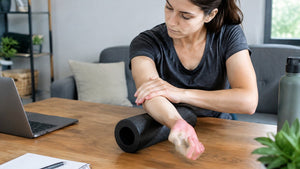
Is a Handheld Massager Worth It for Dental Hygienists?
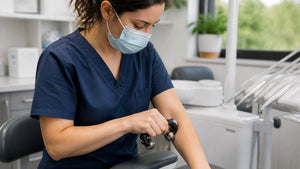

Last Updated: November 2, 2026
Quick Summary
A handheld massager is worth it for dental hygienists because it offers a portable way to ease hand, wrist, and forearm tension during a clinical shift. Choose one with adjustable pressure, cordless portability, and a design you can use one-handed when your grip is already spent.
- Use a handheld massager in three windows: a pre-shift warm-up, a turnover reset, and a post-shift session.
- During turnover, massage the forearm rather than the hand so you stay ready for the next glove-up.
- Score candidates out of five on fit, pressure control, session length, cleaning, noise, and portability.
- Daily short sessions beat one long weekly session because the goal is a routine you will keep.
- A non-electric compression tool needs no batteries or charging, so it lives in a work bag without maintenance.
Table of Contents
- Why Dental Hygienists Feel Hand and Wrist Tension
- What to Look for in a Handheld Massager
- Manual Hand and Forearm Massager Options for Clinical Days
- Electric Hand Massager Comparison: Heat, Vibration and Kneading
- Portable Hand Massager Choices for Between Appointments
- How to Use a Handheld Massager During a Dental Shift
- Choosing Your Hand and Forearm Massager
- Frequently Asked Questions
Why Dental Hygienists Feel Hand and Wrist Tension
A dental hygienist performing scaling and root planing holds a pin-thin instrument in a precise grip for most of a working day. That sustained grip pressure, repeated thousands of times per week, is why so many clinicians finish a shift with tired hands and tight forearms.
The pattern is well documented in occupational health literature: prolonged static grip and fine motor repetition load the small muscles of the hand and forearm. The National Institute for Occupational Safety and Health guidance on musculoskeletal disorders describes how sustained forceful gripping contributes to soft-tissue fatigue in the upper limb. Translation for a hygienist: the discomfort is a workload issue, not a personal weakness.
Below, we break down what to look for, how electric and manual options differ, and how to work a massager into a real clinical schedule.
What to Look for in a Handheld Massager
The right device for clinical work balances adjustable pressure, portability, and comfort in the hand that is already tired. A handheld massager is a portable device, manual or electric, that applies pressure, vibration, or kneading to the hand, wrist, and forearm. For hygienists, the deciding factors are pressure control, battery life, and whether it fits in a locker or carry-on.
Pressure Settings and Intensity Levels
Adjustable pressure settings matter more than raw power. A hygienist needs to modulate intensity across a shift: lighter work on the palm after a heavy calculus day, firmer compression on the forearm between patients. Look for devices with clearly distinct intensity levels rather than a single on/off setting, and check that the lowest setting is genuinely gentle.
Battery Life, Charging Time and Cordless Portability
A cordless massager with a rechargeable battery is the practical choice for clinical settings. Check three numbers before buying: battery life per charge, charging time, and device weight. A device that runs for a full shift on one charge and recharges over lunch removes the friction that kills daily-use habits. Measure whether the unit fits in your bag, because a massager that stays home is less likely to be used.
Manual Hand and Forearm Massager Options for Clinical Days
Manual devices deserve serious attention because they never need charging and can be used in a staff room in the two minutes between patients. A manual hand and forearm massager applies pressure through levers, rollers, or compression mechanisms operated by the user's other hand. The trade-off is effort: you are applying the force yourself, which is why a well-designed lever or compression mechanism matters.
For hygienists who want to go deeper on technique, our guide to deep tissue forearm massage techniques walks through specific strokes and pressure points you can work between appointments. The advantage of a manual option is control and zero downtime. The drawback is that it asks something of the hand that just finished a full day of instrumentation.
Electric Hand Massager Comparison: Heat, Vibration and Kneading
An electric hand massager comparison for hygienists should be judged on fit, pressure control, session length, cleaning, noise, and portability, not on the feature list on the box. Most buying guides compare modes; this one compares how each mode behaves in an operatory and a staff room.
Type |
What It Does |
Best Fit in a Clinical Day |
Watch Out For |
|---|---|---|---|
Heat therapy |
Warms the contact surfaces before or after use |
Stiff hands at shift start, or a warm-up before the first patient |
Not for use on swollen or irritated areas; check the manufacturer's guidance |
Vibration massage |
Rapid oscillation for light stimulation |
A quick reset between patients |
Can feel numbing at high settings; low settings matter more than top speed |
Kneading massage |
Rolling compression of muscle tissue |
Forearm and palm tension after a long day |
Bulkier units are less portable and louder in a shared break room |
Heat. The practical questions are how fast the unit reaches temperature, whether the heat is adjustable, and whether the contact surface can be wiped down between uses. A unit that takes ten minutes to warm up will not fit a two-minute break.
Vibration. Vibration suits a fast mid-shift reset. Look at the lowest setting first: a genuinely gentle low speed is more useful between patients than a high speed you rarely use.
Kneading. Kneading delivers the firmest compression and is the closest to what a massage therapist does by hand. It is also the bulkiest and loudest category, which is why it tends to live at home rather than in a locker.
Comparison Criteria That Actually Matter for Clinical Use
When you line up two electric units side by side, score them on these six points rather than on mode count:
Roleo Arm & Hand Massager – BACK IN STOCK! Effective, easy to use. Our →
- Fit. Does your hand sit in it without gripping? A hygienist's grip is already spent by mid-shift, so a device that requires holding defeats the purpose.
- Pressure control. Are the intensity levels clearly distinct, and is the lowest setting genuinely gentle?
- Session length. Does it run long enough for a five-to-ten-minute session without a timer cutting out, and does it auto-shut-off at a sensible point?
- Cleaning. Can the contact surfaces be wiped between uses? Shared break rooms make this non-negotiable.
- Noise. Would you use it in a staff room with a colleague on the phone?
- Portability. Does it fit a locker or tote, and what does it weigh in the bag?
Portable Hand Massager Choices for Between Appointments
Portability decides whether a device actually gets used. A portable hand massager should fit in a locker, a tote, or a carry-on without adding meaningful weight. Non-electric designs have a structural edge here: no battery, no cable, no charging brick.
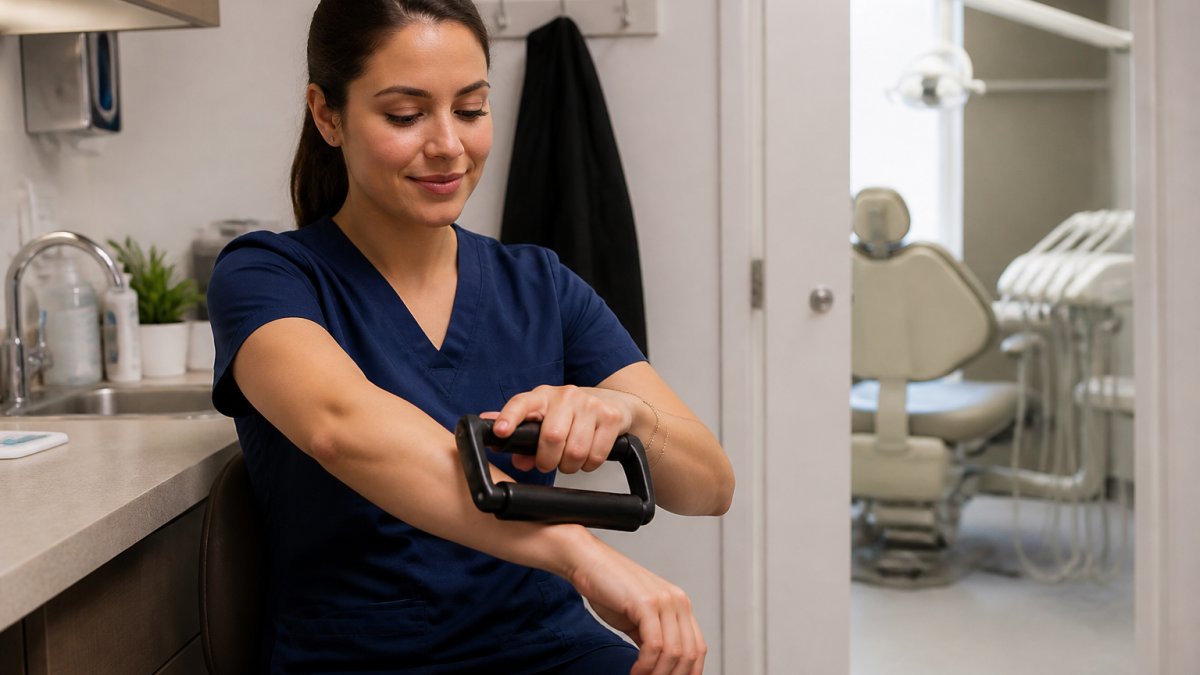
This is where the Roleo Arm & Hand Massager fits the brief. It is a non-electric, portable self-massage tool built around the compression mechanics of a traditional clothes wringer, designed for the forearms, wrists, and hands. It needs no batteries or charging, so it lives in a work bag without maintenance. The compression level can be adjusted to your preference.
How to Use a Handheld Massager During a Dental Shift
You can use a handheld massager during a dental shift in three short windows: a warm-up before the first patient, a reset between appointments, and a longer session after the last patient. What makes this different from a generic routine is the appointment cadence, hygiene schedules run in 30-, 45-, and 60-minute blocks, and the usable window is the turnover between patients, not a lunch break you may not get.
Here is a routine built around that cadence:
- Pre-shift warm-up (2-3 minutes). Before the first patient, work the palm and forearm with light pressure. The goal is to start the day with a relaxed grip rather than a cold one.
- Turnover reset (60-90 seconds). Between patients, while the chair is being reset, work the fleshy area below the elbow with moderate pressure. Keep it to the forearm so you are not massaging a hand that is about to re-glove.
- Post-shift session (5-10 minutes). After the last patient, use firmer compression across the forearm and hand, moving slowly through tight spots rather than parking on one.
- Consistency check. Daily short sessions beat one long weekly session, because the goal is a routine you will actually keep.
Fitting It Around a Real Appointment Schedule
A few practical constraints shape how this works in a real operatory:
- Gloves and hand hygiene. Massage the forearm, not the hand, during turnover, it keeps your hands free for the next glove-up and avoids interrupting hand hygiene.
- Noise and privacy. A quiet device or a non-electric tool is easier to use in a shared staff room without drawing attention.
- Storage. A device that lives in your locker or tote gets used; one that lives at home does not. This is the single biggest predictor of whether a routine sticks.
- One-handed operation. By mid-shift your grip is spent, so the device should not require you to hold it firmly with the hand you are working on.
What a Massager Can and Cannot Do
It is worth being clear about scope. A handheld massager is a comfort and relaxation tool for hand, wrist, and forearm tension. It does not replace ergonomic adjustments, breaks, or stretching; a massager is best used alongside them.
For step-by-step operating instructions, see our guide on how to use the massager, and for a visual walkthrough, watch the Roleo video tutorial. A common mistake is pressing hard on a sore spot and stopping there. Move through the whole forearm instead, and keep pressure within a comfortable range.
Choosing Your Hand and Forearm Massager
Choose a device that matches how you actually work, not the most feature-heavy option on the shelf. Prioritize adjustable pressure, portability, and a design you can use one-handed when your grip is already spent. Electric models with heat and vibration suit clinicians who want variety; manual compression tools suit those who want zero charging and instant readiness.
One insider point most buying guides miss: the best device is the one that survives a real schedule. For a practical cost-benefit breakdown to decide whether buying a massager makes sense, see Is Wrist And Forearm Massage Worth The Cost A Practical Breakdown. If it needs charging every other day or weighs down your bag, it will sit in a drawer by month two.
You can see the full specification and current availability on the Roleo Arm & Hand Massager product page. It is a non-electric, portable option built for exactly this kind of daily self-care habit.

Frequently Asked Questions
What features should dental hygienists look for in a handheld massager?
Prioritise adjustable pressure, good hand and forearm coverage, and a grip that stays comfortable through a full session. A manual hand and forearm massager gives you direct control over pressure. Check device weight, noise level and ease of use, since you may use it in a shared break room. Cordless and rechargeable designs are easier to keep in a locker or bag.
Is a manual or cordless massager more convenient for a dental hygienist?
It depends on where you plan to use it. A manual hand and forearm massager needs no battery or charging, so it works anywhere.
How do you clean and store a handheld massager at the dental office?
Store it in a locker, drawer or carry case rather than on a counter. A portable hand massager that packs into a small case is easiest to store.
What is the difference between a hand massager and a forearm massager?
A hand massager focuses on the palm, fingers and grip area, while a forearm massager works the longer muscles that control wrist and finger movement. Hygienists often feel tension in both, so a tool that covers the forearm and hand together is more versatile. The Roleo Arm & Hand Massager offers adjustable pressure for the forearm, wrist and hand.
Dental hygiene work asks a lot of your hands, and the tension that builds over a career deserves more than an occasional stretch. Roleo Massager offers a non-electric, portable self-massage tool with adjustable pressure, designed for the forearms, wrists, and hands and trusted by therapists and trainers since 2006. Build a short daily routine around it, and give your hands the recovery they have earned. Get started with Roleo Massager and make hand care part of every shift.

- Paul Kleiman