Arm Massage Tool for Forearm Discomfort: 2026 Guide


Table of Contents
- Arm Massage Tool for Forearm, Wrist and Hands: What Actually Helps
- Manual vs Electric Arm Massagers: Which Suits Forearm Tension
- How to Use a Forearm Massage Tool Without Making Tension Worse
- Massage Tool Usage Duration: How Long Is Too Long
- Features That Matter in an Arm Massage Tool for Tendonitis
- Red Flags: When to Skip Self-Massage and See a Professional
- Conclusion
- Frequently Asked Questions
Last Updated: October 3, 2026
Arm Massage Tool for Forearm, Wrist and Hands: What Actually Helps
An arm massage tool works best when it delivers steady, controllable pressure to the forearm muscles rather than hammering directly on a painful area. At Roleo Massager, we have spent two decades helping office workers, musicians, and athletes manage everyday forearm tension, and the pattern is consistent: the tool matters less than how you use it.
Discomfort in the elbow and wrist often traces back to the muscles that pull on those areas. That is why the most useful devices are the ones you can guide slowly along a muscle belly, not the ones that vibrate fastest.
This guide covers manual versus electric options, how long to massage, red flags that mean you should stop, and the features worth paying for. Below, we break down exactly how to use a forearm massage tool without increasing tension.
NHS guidance on elbow and arm pain
Manual vs Electric Arm Massagers: Which Suits Forearm Tension
Manual arm massagers suit most people with forearm tension because you feel exactly how much pressure you are applying. Electric percussion guns deliver speed and reach, but they remove some of that feedback.
The choice comes down to three things: how much control you want, where you plan to use it, and what you are willing to spend.
Pressure Control and Feedback
With a manual tool, your own hand sets the depth. You can ease off the moment a spot feels sharp rather than dull and achy. That distinction matters when you are working near an area that feels sensitive.
Electric devices push at a fixed rate. You adjust by hovering closer or further away, which is less precise. Many people find they press harder than they intended with a percussive gun because the vibration masks the sensation.
Portability, Noise, and Cost Trade-Offs
Manual tools win on portability and silence. There is nothing to charge, nothing to plug in, and nothing that hums during a work call. A spring-loaded roller such as the Roleo Arm & Hand Massager fits in a laptop bag and needs no batteries.

Electric massagers tend to cost more, weigh more, and require charging. They can cover larger areas faster, which helps if you are working on thighs or calves as well as arms.
Feature |
Manual Arm Massager |
Electric Percussive Massager |
|---|---|---|
Pressure control |
You set it by hand |
Fixed speed, adjusted by distance |
Feedback |
Direct feel of the tissue |
Dulled by vibration |
Portability |
Fits in a bag, no power |
Bulkier, needs charging |
Noise |
Some spring noise |
Audible motor hum |
Best for |
Forearm and wrist work |
Larger muscle groups |
How to Use a Forearm Massage Tool Without Making Tension Worse
Using a forearm massage tool safely means working the muscle, not directly on sensitive areas. Move slowly, keep pressure moderate, and stop short of sharp discomfort.
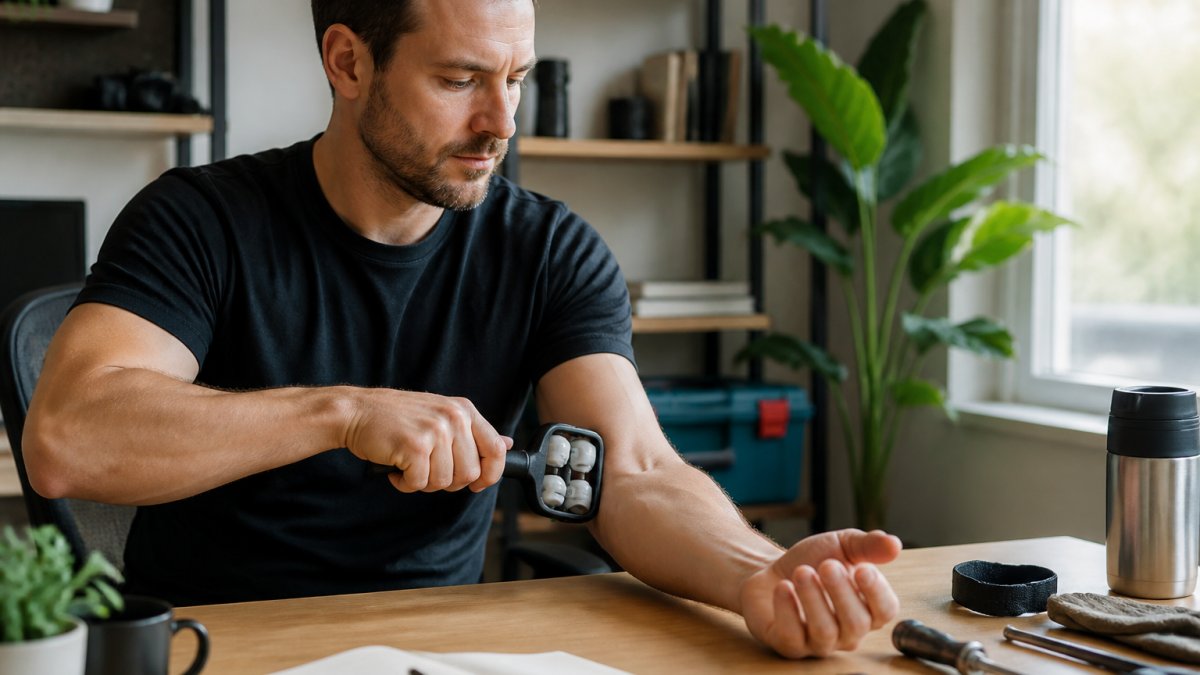
A common mistake is rolling directly over a sensitive spot on the elbow. That point is often a tendon, and pressing into it tends to increase discomfort rather than settle things. Work the fleshy part of the forearm instead, a few centimetres back from the joint.
Step-by-Step: Forearm and Wrist Routine
- Warm the area first with a hot shower or a few minutes of gentle movement.
- Rest your forearm on a table, palm up.
- Place the tool on the muscle belly, about two-thirds of the way from wrist to elbow.
- Roll slowly toward the elbow, then back toward the wrist. Roughly one half inch (or one centimeter) per second.
- Spend 30 to 60 seconds per pass, then move to a slightly different angle.
- Turn the arm over and repeat on the top of the forearm.
- Finish with slow wrist circles and finger stretches.
Massage Tool Usage Duration: How Long Is Too Long
Two to five minutes per forearm is the sweet spot for most people. Longer sessions rarely add benefit and often leave the tissue tender the next day.
Think of it like stretching. A little, done consistently, beats a long session once a week. Many people find that a short routine in the morning and again after work keeps tension from building up in the first place.
Signs you have gone too long include next-day soreness that feels like a bruise, and skin that is red and warm for hours afterward. If that happens, cut your session in half and use lighter pressure.
The Roleo Leg Massager uses the same principle for arms, with a spring-loaded roller that lets you adjust tension by changing the angle. Its listing notes it is designed for use on forearms as well as legs, which makes it a practical second tool if you want something lighter for warm-ups.

Features That Matter in an Arm Massage Tool for Tendonitis
The features worth paying for are the ones that change how the tool behaves in your hand. Everything else is decoration.
Roleo Arm & Hand Massager – BACK IN STOCK! Effective, easy to use. Our →
Look for adjustable pressure, a shape that fits around a forearm, and a surface that glides rather than drags. Non-electric designs have an advantage here because there is no motor weight pulling the tool off course.
Portability matters more than most buyers expect. A device that lives in a drawer gets used far less than one that stays in your work bag. If you travel, check the actual dimensions rather than trusting a "portable" label.
Durability is the other quiet factor. A tool with a spring mechanism will hold its resistance over years, while cheap plastic housings tend to loosen. Since these devices are used daily by many people, that longevity is what separates a good buy from a replacement purchase.
Chartered Society of Physiotherapy advice on self-management
Red Flags: When to Skip Self-Massage and See a Professional
Most guides tell you when to use a massage tool. Far fewer tell you when not to. That gap matters, because a tool that feels fine on comfortable tissue can be the wrong choice on tissue that is already sensitive, swollen, or otherwise not ready for pressure.
Situations Where Pressure Is the Wrong Input
These are the cases where a massage tool is not the right first step. They are not a diagnosis, they are reasons to get a proper assessment before you start a routine.
- Acute, hot, swollen areas. If an area is visibly swollen, red, or warm to the touch, adding pressure tends to increase irritation rather than settle it. Wait until the area looks and feels calm before considering any self-massage.
- Numbness, tingling, or pins and needles in the fingers or hand. These sensations point to nerve involvement, and pressing on or around a nerve can make symptoms worse. This is a clinician conversation, not a tool conversation.
- Weakness in your grip or difficulty holding everyday objects. Sudden or progressive weakness is a reason to stop and get assessed.
- A recent fall, impact, or injury. Bruised or potentially injured tissue should not be worked with a roller or percussive device until a professional has looked at it.
- Known circulation or clotting issues. If you have a diagnosed condition affecting blood flow, check with your doctor before using any pressure-based tool.
- Pain that wakes you at night or is steadily worsening over weeks. A pattern that is getting worse rather than easing is a signal to change approach, not to push harder.
- A diagnosed condition affecting tendons, nerves, or joints. If you already have a named diagnosis, ask your doctor or physiotherapist whether self-massage fits your situation and, if so, how.
Why These Matter for Tool Choice
A percussive device delivers rapid, repeated impact. A manual roller delivers slower, broader pressure. On calm, healthy muscle, both can feel pleasant. On tissue that is very sensitive or near a nerve, the faster and more forceful option is usually the one to avoid first.
That is why the sensible default is: when in doubt, use less pressure, use it further from the sensitive spot, and shorten the session. If a spot feels sharp rather than a dull sensation, you have moved off the muscle. Back off and work a few centimetres away.
A Simple Rule for Everyone Else
For most people with everyday forearm tension and no red flags, the approach is straightforward. Use moderate pressure, keep sessions short, work the muscle rather than the tendon, and treat any sharp increase in discomfort as a stop signal rather than something to push through.
If you are unsure whether your situation falls into the red-flag list above, the safest move is to ask a clinician before starting. A tool is a maintenance aid for comfortable, healthy-feeling tissue, not a substitute for assessment.
Conclusion
Forearm tension builds quietly, and by the time it interferes with typing, playing, or training, it has usually been developing for months. A short, consistent self-massage routine is one of the few things you can incorporate into your wellness process.
At Roleo Massager, we built our arm and hand massager around exactly that idea: adjustable pressure, no batteries, and a design that fits a forearm properly so you actually use it. It costs less than a single professional massage and lives in your bag, ready when tension starts to build.
Frequently Asked Questions
What features should I look for in an arm massage tool?
Focus on adjustable pressure, a shape that wraps or rolls along the forearm, and a surface that reaches the wrist and hand. Non-electric options like the Roleo Arm and Hand Massager let you control pressure by hand, which matters when tendons feel sensitive. Portability and ease of cleaning also count if you plan to use it at a desk or gym.
How does a manual arm massager differ from a massage gun?
A massage gun delivers rapid percussive pulses, while a manual tool relies on rolling or wringing action you control. For forearm tension, manual tools give slower, more deliberate pressure and let you ease off the moment something feels sharp. The Roleo Arm and Hand Massager uses a wringer-style motion designed for forearms, wrists, and hands rather than broad muscle groups.
Can arm massage tools be used on the hands and wrists?
Yes, many are built for exactly that. The Roleo Arm and Hand Massager is designed for forearms, wrists, and hands, and the Roleo Leg Massager also works on arms for biceps and triceps. Keep pressure light over bony areas like the wrist joint, and focus on the fleshy forearm muscle rather than pressing directly on a sensitive area.
How often should I use a handheld massager for arm tension?
Short, frequent sessions tend to work better than one long one. Try 5 to 10 minutes per forearm, once or twice a day, and skip a day if the area feels uncomfortable. Consistency matters more than intensity, so build it into a routine after work or before playing an instrument rather than only when tension peaks.
If tension in your hands, wrists, and arms keeps returning, a tool you will actually use every day matters more than a tool with the longest feature list. Roleo Massager offers adjustable pressure, a non-electric portable design trusted since 2006, and a shape built specifically for forearms, wrists, and hands. Get started with Roleo Massager and make short daily self-massage part of your routine.
- Paul Kleiman